



For sale SIA
✅ Key points at a glance — Sale of an SIA (company) via URonline ✔Price: customized offer following a free company valuation ✔Payment: to your bank account


A share capital increase is a legal and financial process whereby the members of a company decide to increase the company's subscribed share capital beyond the original amount by contributing additional funds or assets.
The manual complies with the changes in Commercial Law, which takes effect on January 1, 2026.

Before you start the share capital increase process, make sure you have everything you need for a quick registration.
The process of increasing share capital consists of several steps, including entry in the Commercial Register of the Register of Companies.
Below you will find the sequence of the Share Capital Increase process.
The Member or the Meeting of Members shall decide on the increase of the share capital. The terms and conditions of the share capital increase shall be drawn up and approved.
Existing or new members subscribe to the new share capital.
The main founding documents are
Most of these model documents can be found and customised on the Register of Companies' website.
The new shares are paid for in cash or in kind.
The share capital is payable in full by the time of application.
The new shares may be paid for by a cash deposit into the company's bank account or by a contribution in kind, the value of which has been certified by a certified valuer or by the Board itself (in cases provided for by law).
The cash contribution must be paid into a bank account or into the company's cash desk.
More about options for contributing to the authorized capital – Authorized Capital of an SIA: Tips and Options.
Documents must be signed with a secure electronic signature (eID card or eParaksts mobile), which is the fastest and cheapest way to start a business.
If a participant does not have an e-signature, signatures will have to be notarised, which will incur additional costs and time. The signatures of all founders on the application and the register of members must be simultaneous.
The application and accompanying documents must be submitted electronically via the Enterprise Register’s customer self-service portal.
Upload your documents to the Register of Companies portal and pay the state fee 40.00 EUR.
A share capital increase in a small-capital LLC is a legal and financial process in which the members of the company decide to increase the company's subscribed share capital above the initial limit (EUR 1-2799) by contributing additional funds or assets.
The status of a small-capital LLC is a popular way to start a business in Latvia, but as the company grows, increasing the share capital becomes an inevitable step to ensure sustainability, obtain loans or participate in tenders.In 2026, the process has become even more digitised, integrating e-signature and automated verification systems of the Register of Companies (UR).
The main reasons for increasing the share capital are to improve the company's creditworthiness, to increase its prestige with business partners and the legal obligation to reach the full share capital (€2,800) before dividends are paid in full or the composition of the shareholders is changed.
Banks and non-bank lenders use improved algorithms to assess credit risk. Small-cap LLCs with share capital of €1 are often classified as high-risk entities. By increasing the share capital to at least EUR 2 800, the company demonstrates stability and the willingness of the members to take responsibility with their assets.
Many state and local government contracts, as well as large private tenders, require a certain amount of share capital. In an economic environment dominated by security and reliability, the status of a "full capital" LLC is the ticket to serious projects.
In 2026, the condition still applies: at least 25% of profits must be allocated to the mandatory reserve each year until the full share capital or reserves are reached and the share capital amounts to EUR 2,800.
Extraordinary dividends. In accordance with the Commercial Law, a limited liability company determines and pays dividends in accordance with a resolution of the shareholders’ meeting. The company’s shareholders may adopt a resolution on the payment of dividends every 3 months following the payment of the previous dividends. It should be noted that an SIA must not have any tax arrears, and the company may pay out no more than 85 percent of the profit earned during the period for which the special dividends are determined as special dividends.
The payment of extraordinary dividends could provide significant relief to service providers or micro-enterprises when, under certain conditions, they are not required to pay wages.
The corporation tax (CIT) on dividend payments is 20%.
Extraordinary dividends are prohibited in a small-capital LLC.
Companies can increase their share capital in two ways: by a cash contribution to the company's bank account, or by a pecuniary contribution of valuable assets (machinery, real estate, intellectual property) to the company.
This is the simplest and most commonly used way. Members pay cash or transfer money to an LLC account.
Advantage: No valuation of the financial contribution is required.
Process: Contribution -> UR application.
If the share capital is increased by assets, their value must be confirmed.
The founders may provide an opinion on the valuation of the contribution.
If the total value of the pecuniary contribution does not exceed EUR 25 000 and the pecuniary contribution together amounts to less than half of the company's share capital, the founders may value the pecuniary contribution and give their opinion.
In other cases, the in-kind contribution is evaluated and an opinion on it is provided by a person included in the list of property contribution appraisers.
Although a small-capital LLC (with share capital between €1 and €2,799) can operate for a long time, the law lays down certain conditions that gradually move the company towards full capital.
The obligation to increase the share capital of a small-capital LLC to the standard amount (at least EUR 2,800) arises when the company no longer meets the characteristics of a small-capital company set out in the Commercial Code or when the members wish to pay dividends without complying with the mandatory reserve accumulation conditions.
A small-capital LLC (limited liability company with reduced share capital) is a flexible format for starting a business, but the Commercial Companies Code provides for specific situations in which an increase in share capital becomes a mandatory legal requirement.
Failure to meet the criteria for a small-capital LLC: The company is obliged to increase its share capital to EUR 2,800 if any of the following circumstances occur:
Change in membership: A legal person becomes a member.
Increase in the number of participants: The number of members exceeds five natural persons.
Board changes: A person who is not a member of the company becomes a member of the Management Board.
Participation in another small-capital enterprise: A member becomes the sole owner of another small-capital LLC.
Distribution of profits and payment of dividends:
Small-cap LLCs are required to build up a minimum reserve of at least 25% of net profits each year. If the company wishes to pay dividends but the accumulated minimum reserve and the paid-up share capital together do not amount to EUR 2 800, the company must first provide for a capital increase. The most practical solution in such a situation is to increase the share capital by capitalising the accumulated reserve.
Limited companies with a share capital of less than €2,800 have a legal obligation to accumulate a share of profits each year to strengthen the company's financial stability.
These rules are designed as a safety net: because the company's initial capital is small, the State requires it to gradually "grow" its safety cushion.
Each year, the company must "set aside" at least 25% of its net profit, including it in the mandatory reserve.
If your Ltd has made money during the year, you can't spend it all at once or pay it to yourself. A quarter of the profits should be kept in a company account as a non-touchable provision until the company is financially stronger.
The statutory reserve may be used for two purposes only: to increase share capital or to cover unexpected losses.
This money is not for everyday spending or bonuses. It should only be touched if:
You want to increase your company's share capital (e.g. to reach the full €2,800).
The company has incurred losses that cannot be covered from other sources.
The use of this money is always decided by the owners (members) of the company in a meeting.
When preparing the annual report, the Board must specify exactly how much of the profit will go into the minimum reserve.
The Board cannot simply distribute profits in silence. The documents must clearly show: "This amount is being allocated to savings because it is required by law." This helps owners and creditors understand the true financial position of the company.
Owners may only receive as dividends the portion of profits left over after 25%'s contribution to the minimum reserve.
A simple example: if a company earns €1,000, at least €250 must be kept in reserve. Owners can pocket a maximum of €750 as dividends. The law prohibits the payment of all profits if the company's capital has not yet been consolidated.
Below you will find the necessary documents for a share capital increase.
Sample documents can be found on the Company Register website.
Completing and submitting documents accurately requires specific knowledge and expertise.
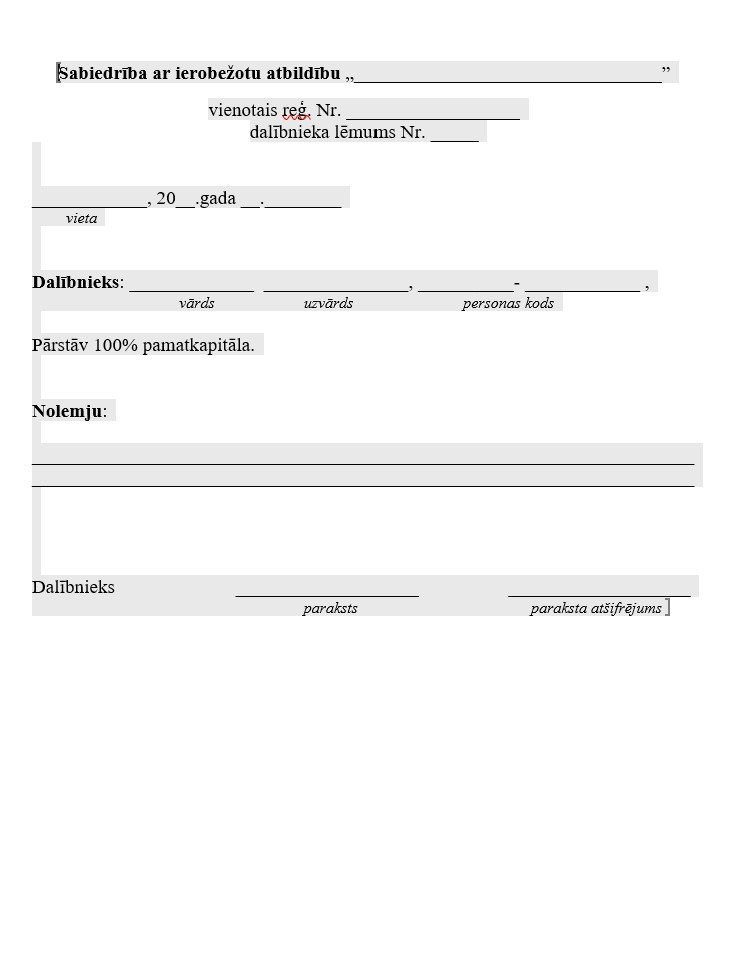
The minutes of the meeting of members or a resolution resolving on the increase of the share capital, containing the terms of the increase of the share capital and amending the statutes.
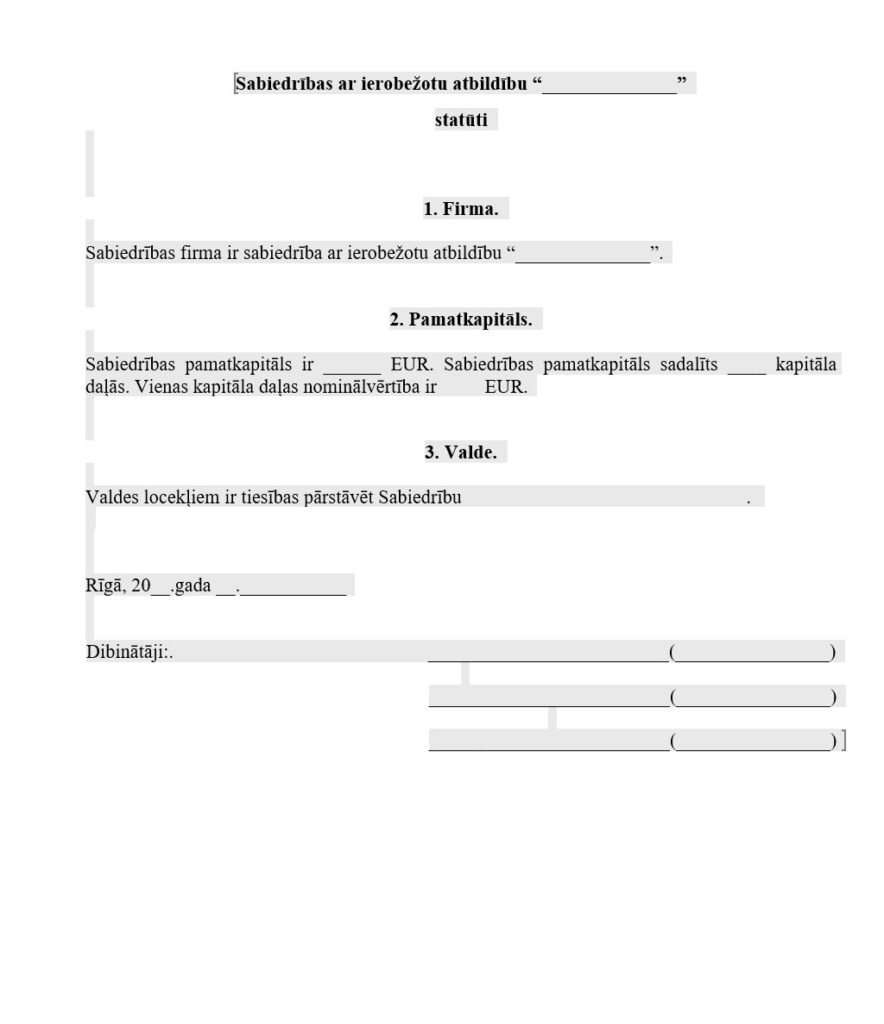
The statutes lay down the main principles governing the company's activities.
The Statutes shall be signed by the Management Board and by the persons who signed the minutes of the meeting of members or the resolution amending the Statutes.
The statutes should only contain rules and should not include, for example, the registered office, the specific persons who are members and officers, or the distribution of members' shares.
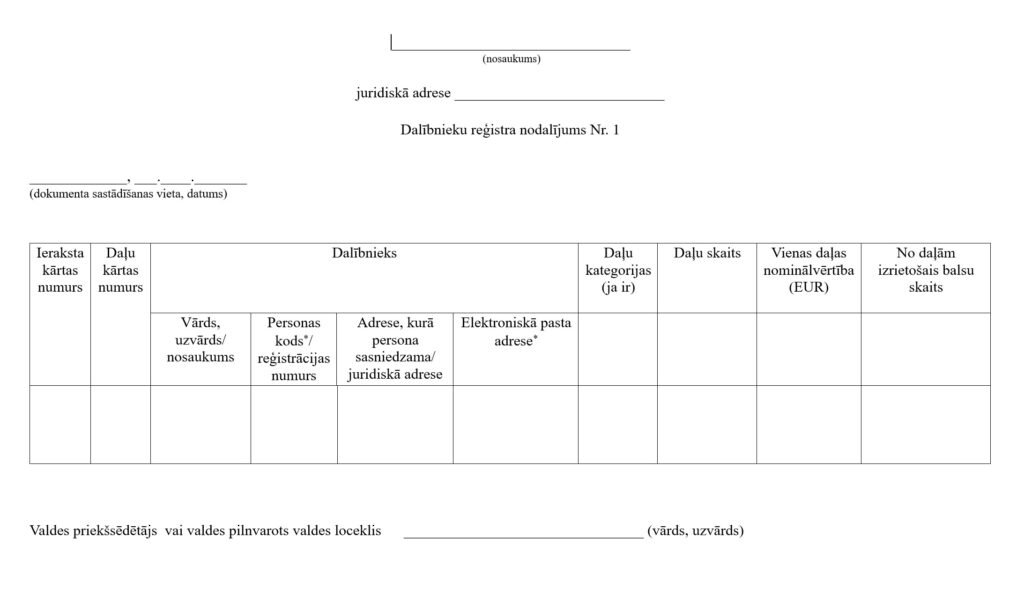
The register of members is a document showing the full composition of the members and the distribution of shares. It shall be signed by the Chairman of the Board or by a member of the Board on the basis of a mandate signed by all the members of the Board.
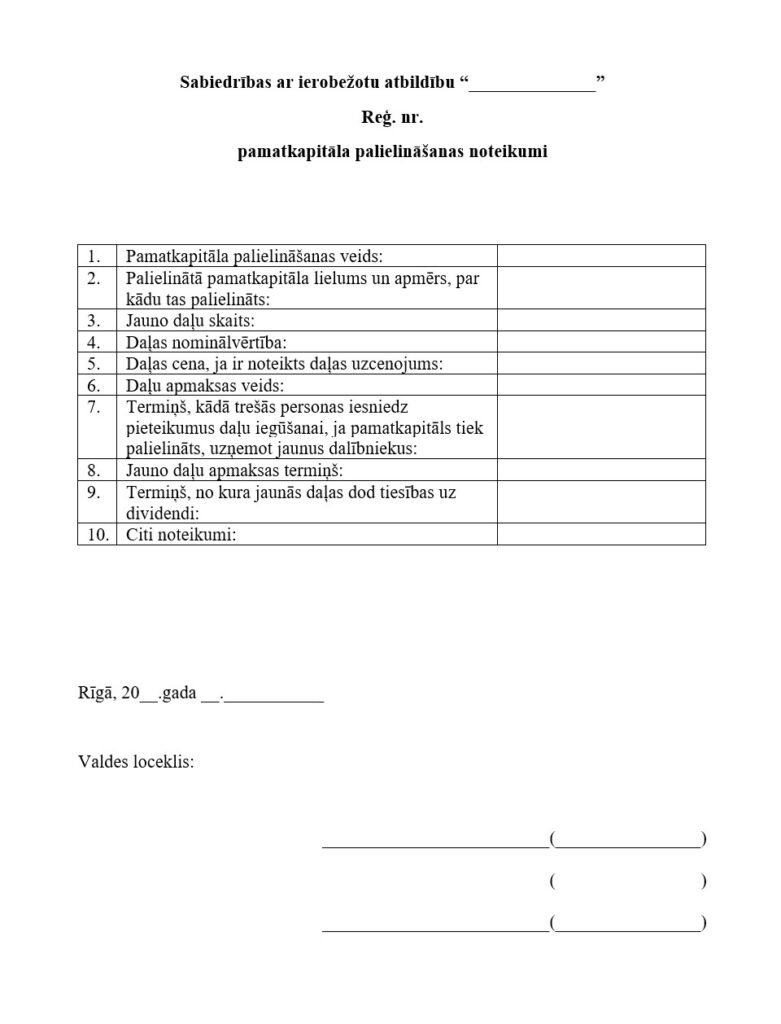
The terms of the share capital increase are signed by the Management Board.
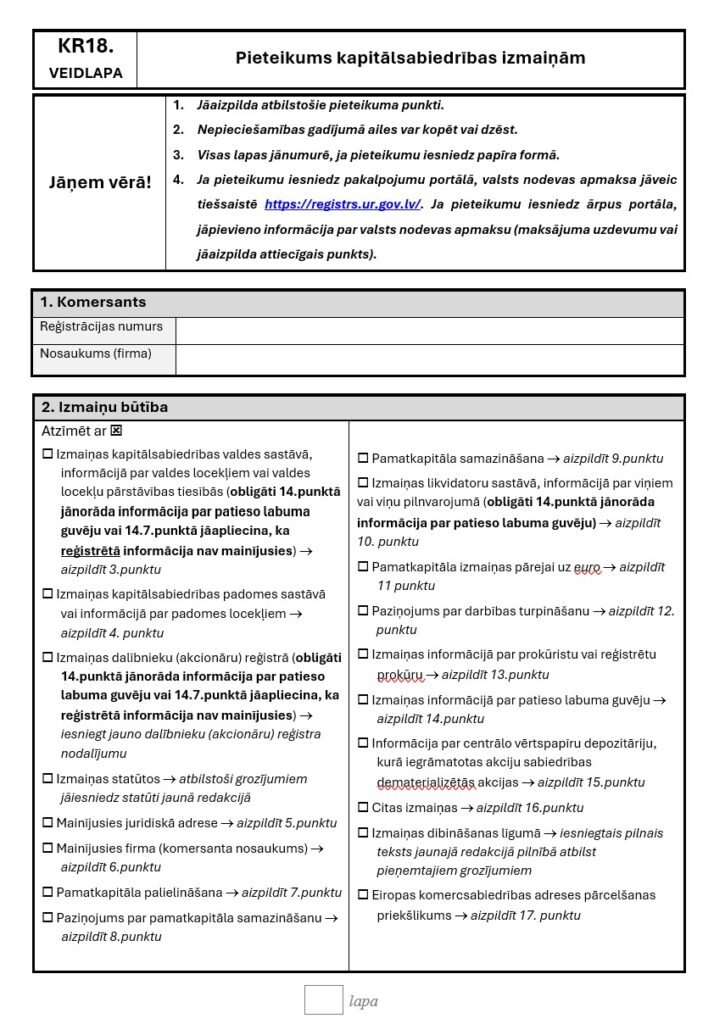
The application form is signed by the Board or a member of the Board.
In cases specified by law, an application for the registration of changes may be forwarded to the State Revenue Service for review. For more information, see the section About the State Revenue Service’s Review of Applications Received by the Enterprise Register.
Documents must be completed in Latvian.
Deadline for submitting documents to the Register of Companies: not set.
The registration costs of share capital increases in Latvia are mainly state fees. The use of e-signatures is generally free of charge.
Documents are submitted and state fees are paid on the Enterprise Register platform.
The cost of preparing the documents for registration in the Register of Entrepreneurs usually ranges from EUR 25 to EUR 120, depending on the price of the service provider and the number of documents to be prepared.
What is included in the URonline Share Capital Increase Service?
Submitting paper documents to the Enterprise Register is a thing of the past. Documents are no longer accepted in person.
However, if you want to file on paper, you have to pay for an expensive notary and send the documents by post.
Registration of an increase in share capital with the Register of Enterprises is an official process for obtaining the status of a legal entity, which takes place electronically on the registrs.ur.gov.lv portal by submitting at least signed documents and paying the state fee.
The Application for an increase of the share capital and the accompanying documents may be submitted by the owners, the board of directors or an authorised person.
Online service.
Documents must be submitted via the Enterprise Register service portal.
Documents must be signed with an e-signature using a smart card (eID or eSignature card) or via the eSignature mobile portal www.eparaksts.lv
You will receive a response via the e-service or at your e-mail address.
Send electronically signed documents to the e-address or to the Enterprise Register's email address.
an email address is a more secure channel of communication between an individual and the state than email.
By post.
Signed documents can be sent to the Register of Companies by post.
The payment order for the stamp duty must be enclosed in the consignment. Please note that only notarised documents can be sent this way, which significantly increases the cost of registering the company.
Authentication of signature and capacity to act on applications and requests to public registers (e.g. Land Registry, Commercial Register) - €23.
In addition, there are fees for data checks, VAT, stamp duty, translation and actual costs.
The application usually takes three working days to process, but an accelerated process (one working day) is also available for an additional fee.
No, the law does not set a specific deadline for the share capital to reach the EUR 2,800 threshold, but it is a prerequisite for full dividend payment and change of status. As long as the share capital is less than €2,800, the company is obliged to build up a minimum reserve from profits each year.
The main advantages are improved creditworthiness of the company with banks, greater credibility with business partners and the right to dispose more freely of the company's profits. Increased share capital serves as a guarantee of financial stability, which is particularly important when bidding for public tenders or seeking investment.
After submitting all the necessary documents to the Register of Enterprises, the notary public examines them within one to three working days on average. The process may take longer if errors or omissions are found in the documents.
The most common problems that can cause the Register of Companies to delay or refuse registration are:
Incorrect application form (KR4).
One of the required documents is missing, such as the consent of a board member.
Documents are not signed with a secure electronic signature (eSignature) or not notarised (if sent by post).
No payment of the stamp duty or proof of payment.
The legal address does not have an accurate cadastral designation or there is doubt about the legal basis for its use.
Although not required by law, the use of a lawyer or other specialist is recommended. Specific knowledge is needed to prepare and submit documents accurately. Errors in the documents may cause delays in the registration process or even refusal by the Register of Enterprises.
Yes, share capital can be increased by a pecuniary contribution (e.g. equipment or immovable property) if this is provided for in the terms of the share capital increase.
he main difference is the size of the share capital. The share capital of a full-capital limited liability company must be at least €2,800, while that of a small-capital limited liability company can be, for example, €1. A general partnership has several advantages, such as greater credibility in the business environment, the possibility to pay extraordinary dividends and the possibility for one person to own several such companies.
It depends on the situation. If a company has only one shareholder, who is also the sole member of the board, and a monthly turnover of less than five minimum salaries (€3,700 in 2025), he may not receive a salary and may pay out the profits in dividends. In this case, the tax burden is lower (only 20% UIT) compared to payroll taxes. However, it should be borne in mind that no social contributions are payable in the absence of a salary.
The application (Form 18), the minutes of the members' meeting, the terms of the share capital increase, the new version of the statutes and the current entry in the register of members must be submitted to the Registry Office. All documents in 2026 must be signed with a secure electronic signature and submitted electronically.
If the share capital is paid up in cash and the amount does not exceed EUR 50 000, a separate certificate from the bank or payment institution need not be submitted to the Register of Companies. The founders must certify in the application form KR4 that a temporary account has been opened in the name of the company to be incorporated and that the share capital has been paid into it.
Payment of the share capital shall be made within the time limit laid down in the terms and conditions for increasing the share capital, but not later than six months from the date on which the decision to increase the share capital is taken. The documents on the increase of the share capital must be submitted to the Registry Office only after all the new shares have been fully paid up.
No, the presence of a notary is not required if the documents are signed with a secure electronic signature (eParaksts or eParaksts mobile).
When the share capital is increased to EUR 2,800, the accumulated minimum reserve can be used to increase the share capital or to cover losses. Once the share capital is fully paid up, the obligation to deduct 25% from the profit reserve each year no longer applies.
The company can continue to operate as a small-capital LLC indefinitely, provided the conditions are met (natural persons on the board, etc.) and a reserve is built up each year from the profits.
Mistakes often occur when the type of company is incorrectly reflected in various documents or when the cadastral designation of the registered office is incorrect.
The Register of Companies may refuse registration if the documents submitted do not comply with the requirements of the regulatory enactments or if the information contained therein is unclear. Often not all the required sections are filled in or there are inconsistencies between different documents (e.g. the memorandum and articles of association).
The name of the company must be unique - it must not be the same as a name already registered or applied for registration. The name must also not be misleading or contrary to good morals. Often founders do not check the availability of a name or try to register a name that is very similar to an existing one.
Registration requires a registered office. Problems arise if the address does not correspond to the National Address Register or if the property owner's consent has not been obtained. If the property has several owners, the consent of all is required. Sometimes an address is given where it is not actually possible to receive correspondence, which can cause problems with public authorities in the future.
For the establishment of a full-fledged LLC (with share capital above EUR 2,800), you need to open a temporary bank account and make a share capital contribution before submitting the documents to the Register of Companies. Errors occur when the contribution is not made in full or by someone other than the founder.
The law requires disclosure of information about the beneficial owners of the company - natural persons who directly or indirectly control the company. Failure to provide this information or providing false information is grounds for refusal of registration.
The articles of association must contain certain details, such as the company's name, the amount of share capital and the number of board members. No details of the founders or registered office may be given, as this information may change and is recorded in other documents.
Make sure the documents are in the correct format.
Documents must be signed with a secure electronic signature and time stamp.
Before submitting the documents, you must make sure that the amount of the stamp duty is correct and that you have paid it. Any incorrect or overpaid amount can be recovered by applying to the Companies Registry.
If the UR finds an error, the notary public postpones the decision for up to 30 days, pointing out the deficiencies. It is important to react promptly to such decisions and make the necessary corrections so that the registration process is not delayed and stamp duty is not lost.
A person who has been disqualified from exercising commercial activity by a court judgment or who is included in the SRS list of persons at risk cannot be appointed as a member of the Management Board. Similarly, a member of the Supervisory Board of the same company may not be a member of the Management Board.
If there are several members on the board, it is necessary to determine precisely their rights of representation - whether each can act alone or only together. A situation should not arise where one member has only a formal right of representation.
Website of the Register of Companies (UR): [https://www.ur.gov.lv/]
State Revenue Service (SRS) website: [https://www.vid.gov.lv/]
Commercial Law: [https://likumi.lv/]
✅ Key points at a glance — Sale of an SIA (company) via URonline ✔Price: customized offer following a free company valuation ✔Payment: to your bank account

What is an Extraordinary Dividend? (2026) An extraordinary dividend is a portion of the net profit for the current reporting period that is distributed to owners,